March 2026 International Technology Industry Report.
In 2026, the world technology ecosystem will undergo a significant change with the advent of AI agents that will be used in place of conventional software in all industries. Organizations are no longer adopting static rule-based systems but are shifting to a system of intelligent, adaptive systems that can think, learn, and act on their own. Not only is this transformation altering the way businesses are being conducted, but it is also redefining how man and technology relate to each other.
The Rise of AI Agents
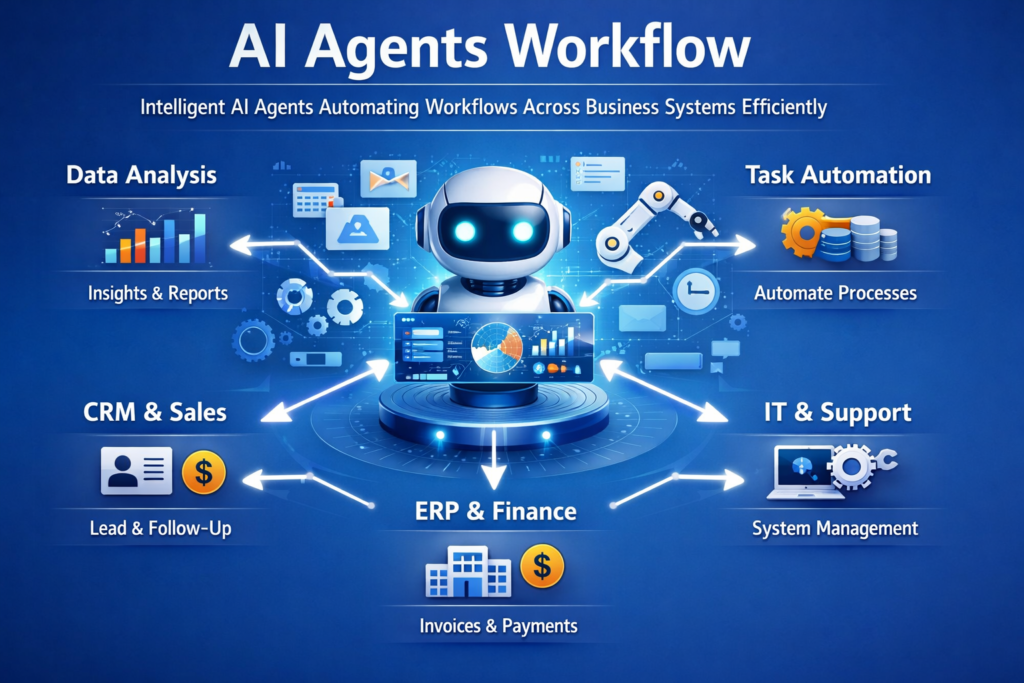
The AI agents are sophisticated computerized systems that are intended to do anything on their own and constantly learn through information and interaction. AI agents are able to learn and enhance with time, as opposed to traditional software that requires fixed programming and manual inputs and is only able to make decisions in real time and understand the context.
These agents will not be restricted to mere automation in 2026. They are transforming into electronic partners who can perform multifaceted workflows, control communication, and even influence strategic decision-making. They are not being used as tools but as part of businesses as teams.
Traditional Software and AI Agents.
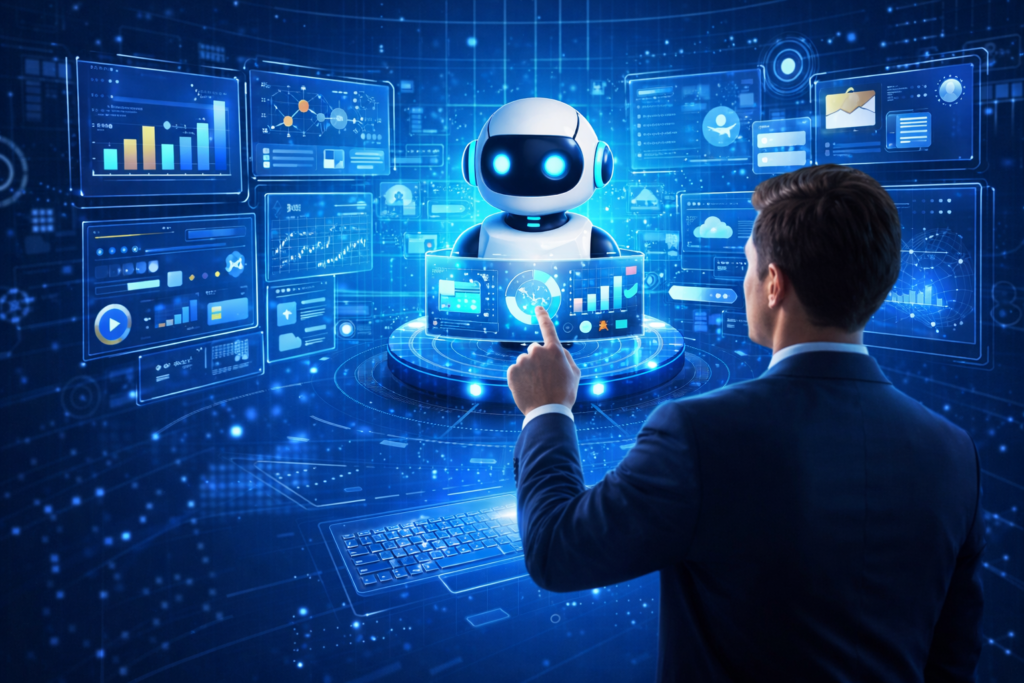
Traditional software has been supporting business operations over decades. It is, however, not so efficient in dynamic settings due to its reliance on preset rules and the need to be constantly updated and monitored by human individuals. These limitations are increasingly becoming visible as industries are becoming more fast-paced and data-driven.
In contrast to that, AI agents are more flexible and intelligent. They are able to change according to dynamic situations, automate intricate practices, and organize customized experiences for the users. Such a learning and evolution capability makes them much more efficient and scalable than traditional systems. Due to this, firms are also shifting towards AI-based software that can adapt to the current needs, rather than the traditional software that can hardly meet them.
Adoption in the industry and its impact in the real world.
The use of AI agents is growing at a high rate in various sectors. Companies in customer service are using AI agents capable of having human-like conversation skills, instantly resolving problems, and learning to improve their answers in future interactions. This has not only contributed much to customer satisfaction but also minimized the costs of operation.
Within the healthcare industry, AI agents are supporting the work of medical professionals by examining patient data, automating their administrative systems, and offering suggestions that enable them to make informed decisions. This enables professionals in medical care to concentrate more on patients and enhance efficiency.
There is also a significant revolution in the financial sector. Fraudulent activities are being detected, trading processes are being automated, and personalized financial recommendations are being provided using AI agents. These not only enhance accuracy but also minimize those risks that relate to human error.
E-commerce sites are using AI agents to control inventory, recommend, and even communicate with customers in real time. This has resulted in better user experiences and increased rates of conversion. Likewise, with software development, AI agents are assisting developers in writing code, finding bugs, and testing the code automatically, which is much faster in the development process.
Key Benefits of AI Agents
- They are highly efficient in automating tedious and complicated work.
- They offer on-demand decision-making as a result of data analysis.
- They keep learning and being enhanced through user interactions.
- They improve customer experience by personalizing the experience.
- They lower the operation costs and enhance output.
Effects on Business and Workforce.
The modern workplace is being transformed by the emergence of AI agents. Although automation is minimizing the demand for some of the repetitive jobs, it is also providing new jobs in fields like AI management, system training, and data analysis. Business firms are currently preoccupying themselves with the creation of hybrid environments in which human beings and AI agents collaborate effectively.
To stay relevant in the changing job market, employees are being encouraged to acquire new skills, which will supplement the AI technologies. This transformation does not concern removing man altogether but making the working experience more productive and intelligent in terms of decision-making.
Difficulties and Dilemmas.
Although there are those benefits, the shift to AI agents has a number of issues. The issue of privacy of data has been a major problem since such systems cannot work efficiently with small amounts of data. Companies should be careful when managing user information.
Ethics are also gaining stronger momentum, especially on bias, transparency, and accountability in AI decision-making. To solve these issues, businesses need to implement explicit rules and regulations of governance.
Also, the process of attaching AI agents to the existing systems may be complicated and demand a significant amount of investment in infrastructure and expertise. The transition strategies should be carefully planned so as to have a smooth and effective implementation of the strategies by companies.
Future Outlook
In the future, AI agents are likely to be the main interface through which man and machine will communicate. These systems will change in the future to be even smarter and be able to process more complicated tasks and still require little human input.
In 2030, several software apps as we know them might be transformed into completely autonomous AI platforms. Such organizations that adopt this change early will most probably have a high competitive edge as their efficiency, innovation, and customer interaction are enhanced.
Conclusion
The AI agents replacing the traditional software in 2026 are a major technological advancement in history. It is not only upgrading the systems but also changing the way businesses work and value is created.
Intelligence, automation, and adaptability are unifying the future of work because of AI agents. This trend is ever-increasing, and thus it will establish a new digital era whereby technology is not only facilitative but also collaborative.
FAQs
1. What are AI agents?
AI agents are smart systems that can do tasks on their own as they learn and enhance their work with information and interactions.
2. Why is it the case that businesses are substituting traditional software with AI agents?
The reason why businesses are embracing AI agents is due to their flexibility, automation, efficiency, and adaptability to changing environments.
3. Are AI agents totally substitutes for human workers?
No, AI agents primarily automate the monotonous work and complement human capacities instead of substituting human workers entirely.
4. What are the problems of the implementation of AI agents?
Some of the key challenges are the problems of data privacy, ethical aspects, and the difficulty of AI integration into existing systems.
5. And what of the future of AI agents?
AI agents will soon become the norm of interaction based on digital means, and sooner or later, many traditional software systems will be displaced.